Operational efficiency in banking today depends on how well systems can process data, respond to inputs, and execute decisions with minimal delay. Manual workflows and fragmented infrastructure often slow performance and increase operational risk. This is where intelligent systems are reshaping the structure of financial operations.
The shift towards automation, supported by broader fintech transformation strategies, is enabling institutions to move beyond basic digital models. In the Philippines, financial institutions are exploring how AI-driven systems can improve accuracy, reduce costs, and support scalable growth.
From Digital Banking to Autonomous Operations
Banking has moved from branch-based systems to digital platforms. The next phase is autonomy, where systems can operate with minimal human input while maintaining control and compliance.
Key developments include:
Transition from rule-based systems to adaptive, self-learning models
Expansion of automation across operations, compliance, and service delivery
Increased focus on reducing operational costs and improving accuracy
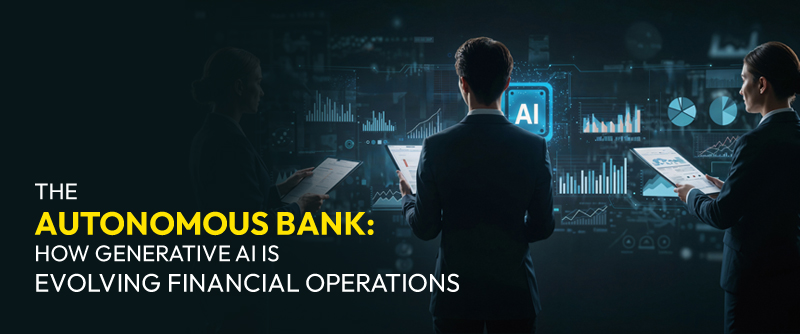
The concept of the autonomous bank refers to systems that can process transactions, detect risks, and support decisions without constant manual oversight. This shift is gaining attention among financial leaders looking to improve efficiency and scale operations.
The Role of Generative AI in Financial Operations
Generative AI is changing how financial institutions manage both internal and customer-facing processes. It supports automation while improving decision-making quality.
Key applications include:
AI-generated responses for customer service and support
Automated document processing and report generation
Assistance in compliance documentation and internal communication
Creation of insights based on historical and real-time data
Integration with big data analytics in finance allows these systems to process large volumes of information and produce relevant outputs. This helps institutions improve speed and consistency across operations.
For organizations adopting fintech transformation strategies, generative AI is becoming a central component of operational design.
Core Banking Transformation Through Intelligent Systems
Legacy systems often limit the ability of banks to scale and adapt. Modern systems focus on flexibility, speed, and integration.
Key trends include:
Migration to modular systems supported by core banking innovations
Use of APIs to connect internal systems with external platforms
Real-time processing of transactions and data flows
Reduced dependency on manual intervention in key processes
These changes allow institutions to deploy new services faster and respond to market demands more effectively. For decision-makers, system modernization is a key step towards building autonomous operations.
Data as the Engine of Autonomous Banking
Data is central to every AI-driven system. The ability to collect, process, and interpret data determines how well autonomous systems perform.
Key priorities include:
Use of big data analytics in finance to support decision-making
Integration of structured and unstructured data from multiple sources
Strong data governance to ensure accuracy and compliance
Conversion of raw data into actionable insights
Financial institutions must invest in data infrastructure to support automation. Without reliable data, AI systems cannot deliver consistent results. Data readiness is not just a technical requirement. It is a strategic factor that affects long-term performance and competitiveness.
Risk, Governance, and Human Oversight
Automation introduces new risks that require careful management. Financial institutions must balance efficiency with control.
Key considerations include:
Managing risks related to AI-driven decisions
Establishing governance frameworks for accountability
Meeting regulatory expectations for AI usage
Maintaining human oversight in critical operations
Clear governance structures ensure that automated systems operate within defined parameters, providing the oversight necessary to manage risk and maintain accountability. Without these guardrails, even the most sophisticated automation can introduce vulnerabilities that undermine institutional integrity. This is essential not only for meeting compliance requirements but for sustaining the trust of regulators, customers, and stakeholders alike.
Ultimately, the goal is not simply to automate processes but to do so in a way that strengthens the institution’s capacity to operate with precision, transparency, and resilience.
Strategic Outlook: Preparing for the Autonomous Banking Era
The move towards autonomous banking will fundamentally reshape how financial institutions operate, affecting workforce roles, system architecture, and competitive positioning across the industry.
Preparing for this shift requires focus across several key areas:
Investment in AI and automation technologies
Alignment with long-term fintech transformation strategies
Building partnerships with technology providers and fintech firms
Strengthening capabilities to compete in regional markets
Platforms like financial innovation conferences play a practical role in this process — giving delegates, sponsors, and C-suite leaders the space to exchange ideas, assess emerging trends, and showcase their strategies against real industry developments. For those navigating this transition, both technical readiness and strategic clarity are essential. One without the other is not enough.
WFIS: Where Financial Institutions & Technology Leaders Align on Strategy
Across the Philippines, financial institutions are already making the decisions that will define how they operate, compete, and scale over the next decade. Generative AI, intelligent automation, and data-driven governance are active components of an accelerating transformation.
The question is no longer whether to ‘move,’ but how quickly and how well.
WFIS therefore brings together the most influential executives, innovators, and decision-makers who are creating the space for strategies to take shape, partnerships to form, and directions to be set.
Key Agenda Topics
‘The Autonomous Bank: Designing AI-Native Operations for Scale and Resilience’
‘Generative AI in Finance: From Experimentation to Enterprise-Wide Deployment’
‘Big Data and Decision Intelligence: Turning Data Infrastructure into Competitive Advantage’
‘Governance in the Age of Automation: Accountability Frameworks for AI-Driven Banking’
Attendee Profile
C-suite executives and senior leaders from Philippine banks and financial institutions
Chief Information, Technology, and Transformation Officers
Operations, data, and AI leads driving internal transformation
Risk, compliance, and governance professionals navigating the automation era
Whether you are evaluating new technologies or building the partnerships that will carry your institution forward, WFIS is where those critical conversations happen.